
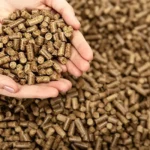


Shrimp farming depends heavily on consistent feed quality. Feed must not only provide adequate protein, energy, vitamins, and minerals, but also have physical properties that match the feeding behavior of shrimp. Because shrimp generally feed near the bottom of ponds or tanks, sinking pellets with suitable water stability are commonly required.
For farms and small commercial feed manufacturers, a shrimp feed pellet machine 1 ton per hour can provide a practical production capacity. It is large enough for regular commercial production while remaining more manageable than a high-capacity industrial feed factory. However, selecting a one-ton-per-hour system requires more than looking at the nominal output of the pellet machine.
The complete production process, raw material characteristics, pellet diameter, working hours, cooling capacity, and storage requirements should all be considered before equipment is purchased.

Why Is Shrimp Feed Different From Conventional Animal Feed?
Shrimp feed has specific physical requirements because shrimp do not normally consume floating feed in the same way as many surface-feeding fish.
A suitable shrimp pellet should sink efficiently and maintain enough structural integrity in water for shrimp to consume it. If the pellet disintegrates too quickly, nutrients can be dispersed into the water before the animals have an opportunity to consume them.
At the same time, pellets should not be unnecessarily hard because excessive hardness can influence feeding behavior and production efficiency.
These characteristics are affected by formulation, raw material particle size, moisture, conditioning, die compression, and cooling.
Consequently, a production line needs to be designed around the actual shrimp feed formula rather than simply selecting a machine according to its motor power.
Is One Ton per Hour Enough?
Whether one ton per hour is sufficient depends on the intended application.
For a shrimp farm producing its own feed, daily feed demand can be calculated from pond area, stocking density, shrimp growth stage, feeding frequency, and the expected production cycle.
Suppose a farm needs approximately seven to eight tons of feed per day. A one-ton-per-hour system operating for eight hours could theoretically meet that requirement. In practical operation, however, the factory also needs time for startup, cleaning, die replacement, maintenance, and formula changes.
Therefore, actual production should be planned with a reasonable operating margin.
For a small feed manufacturer supplying several nearby farms, one ton per hour may provide a useful starting capacity. As demand increases, the factory can potentially add another production line or upgrade selected sections of the existing system.
What Raw Materials Are Commonly Used?
Shrimp feed formulas vary according to species, age, farming system, and nutritional targets.
Common ingredients may include fish meal, soybean meal, wheat flour, rice bran, fish oil, vegetable protein sources, vitamins, minerals, amino acids, and other functional additives.
Each ingredient contributes different physical properties to the mixture.
Fish meal provides protein and can influence the nutritional density of the formula. Wheat flour or other starch-containing materials may contribute to binding. Oils provide energy but can also affect pellet formation when used at relatively high inclusion levels.
Because these materials behave differently during processing, proper grinding and mixing are essential.
Why Is Grinding Important?
Before pelletizing, ingredients normally need to be reduced to a relatively uniform particle size.
Large particles can interfere with feeding stability and pellet formation. Fine and consistent particles provide better contact between ingredients and can help create a more uniform finished pellet.
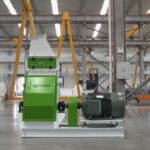
A hammer mill is commonly used in feed processing plants for this purpose. The correct grinding screen depends on the formulation and target product.
After grinding, ingredients are weighed according to the formula and transferred to the mixing section.
Why Does Mixing Matter?
A shrimp feed formula may contain many ingredients in different proportions. If mixing is inadequate, one pellet may contain more protein or additives than another.
A suitable mixer distributes the ingredients throughout the batch and creates a more uniform material before pelletizing.
For commercial production, batching and weighing accuracy are also important. Automated weighing systems can improve formulation consistency and reduce manual errors.
After mixing, the material may be conditioned by adding controlled moisture or steam when required.
How Does the Pelletizing Process Work?
The prepared feed enters the pellet mill through a controlled feeding system.
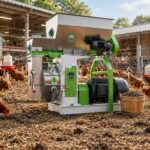
Inside the pellet mill, rollers compress the material against a die. Pressure forces the feed through the die holes, forming continuous strands. A cutter then divides the strands into shorter pellets.
The die determines the approximate pellet diameter, while cutter adjustment affects pellet length.
For shrimp feed, several pellet sizes may be required because shrimp consume different particle sizes at different stages of growth.
A factory producing multiple shrimp feed products may therefore need several die specifications or a production configuration that allows relatively efficient die changes.
What Determines Actual Capacity?
Although the machine may be rated at one ton per hour, actual output can vary.
The formula is one factor. High-fiber ingredients, high-oil formulations, moisture variations, and different pellet diameters can influence throughput.
Die compression also matters. A die designed for a smaller pellet may create different resistance from one designed for a larger pellet.
Material preparation can have an equally important effect. Poor grinding or inconsistent mixing can reduce feeding stability and affect the pelletizing process.
This is why buyers should treat one ton per hour as a target capacity rather than an unconditional production guarantee.
What Happens After Pelletizing?
Fresh pellets leave the pellet mill at an elevated temperature and may contain moisture that needs to be controlled.
Cooling is therefore an important downstream stage. A cooler reduces pellet temperature and improves handling and storage stability.
Screening follows cooling in many production lines. The screen separates fines and particles outside the desired size range.
Fines can often be returned to the production process rather than being discarded.
After screening, the qualified shrimp feed can be transferred to a packaging system. Depending on the market, finished products may be packed into small retail bags, larger commercial bags, or stored in bulk.
How Does Pellet Quality Affect Shrimp Farming?
Feed quality has a direct relationship with feeding efficiency.
A well-formed pellet should have appropriate density, sufficient mechanical strength, and suitable water stability. If the pellet breaks apart too rapidly, feed nutrients can be lost to the water.
Water stability is especially important in shrimp farming because uneaten feed can remain at the bottom of ponds. Excessive feed deterioration may increase organic loading and complicate water management.
For this reason, producers should evaluate pellet quality not only immediately after production but also under actual feeding conditions.
Testing pellets in water can provide useful information about sinking behavior and durability.
Can Shrimp Feed Be Produced by Extrusion?
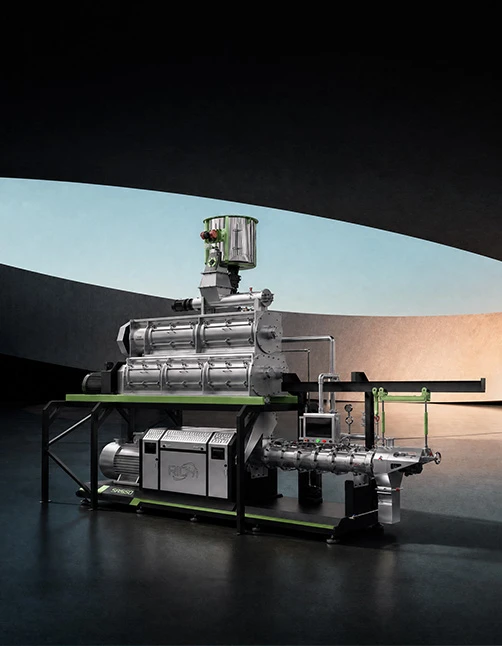
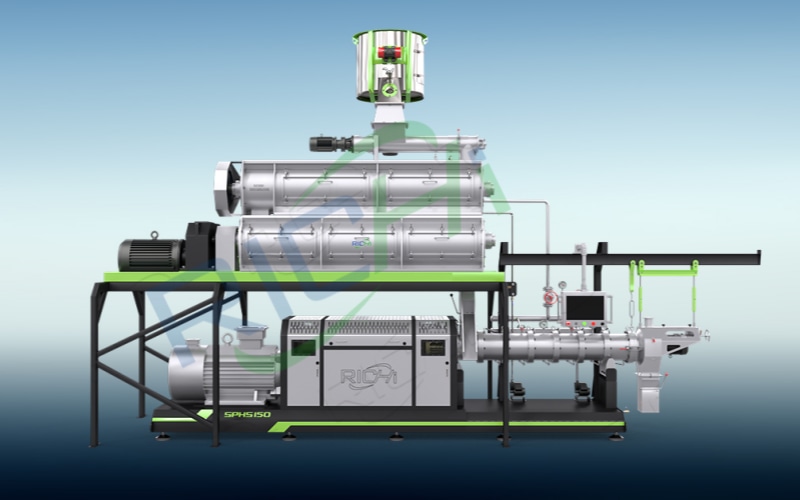
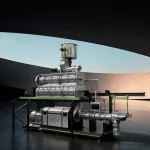
Extrusion is another technology used in aquatic feed production. It can provide greater control over expansion and density and is particularly common for floating fish feed.
However, conventional pelletizing remains an important option for sinking shrimp feed.
For producers comparing different aquatic feed technologies, a floating fish feed production line should be evaluated separately because floating fish feed generally has different density and expansion requirements from sinking shrimp feed.
The correct technology depends on the final product, formula, desired density, moisture level, and production target.
What Auxiliary Equipment Is Needed?
A one-ton-per-hour shrimp feed project normally includes more than the main pellet mill.
A basic process can include:
- Raw material receiving
- Cleaning and screening
- Crushing
- Batching and weighing
- Mixing
- Conditioning
- Pelletizing
- Cooling
- Screening
- Packaging
Conveyors connect the different stages and reduce manual material handling.
Larger systems may use centralized PLC control so that operators can monitor motors, temperatures, feeding rates, and other important operating parameters.
The auxiliary equipment must be properly matched to the pellet mill. If the cooler can process only 500 kg per hour while the pellet mill produces one ton per hour, the downstream section will become a bottleneck.
How Should a Factory Plan Its Raw Material Storage?
Storage is often overlooked during feed factory planning.
A one-ton-per-hour production line can consume a significant quantity of raw materials during a working day. If the factory operates eight hours, approximately eight tons of finished feed may be produced.
The required ingredient inventory will be considerably higher because several raw materials are combined to create the final formula.
Therefore, storage areas should be designed for fish meal, soybean meal, grains, additives, oils, packaging materials, and finished feed.
Proper storage also protects ingredients from moisture and contamination.
What Should a Small Shrimp Feed Factory Consider?
A small factory should avoid investing in equipment that is significantly larger than its actual demand.
A one-ton-per-hour system can be useful because it provides moderate commercial capacity without requiring the infrastructure of a large industrial feed factory.
However, the factory should leave enough space for future expansion.
For example, the layout can reserve areas for additional mixers, pellet mills, coolers, storage bins, or packaging equipment. This can make future expansion easier without requiring a complete factory reconstruction.
The electrical system should also be planned with future equipment additions in mind.
How Can Buyers Compare Suppliers?
Price should not be the only comparison factor.
Buyers should request detailed information about the pellet mill model, motor power, production capacity, die diameter, pellet size range, cooling system, screening equipment, control system, and spare parts.
The quotation should also clarify what installation and commissioning services are included.
Raw material testing is particularly useful for projects involving complex shrimp feed formulas. The same machine can perform differently depending on the actual formulation.
An experienced pellet production line manufacturer can evaluate the complete process and recommend equipment according to the formula rather than simply providing a standard machine.
What About Future Expansion?
Shrimp farming markets can change rapidly. A farm that initially produces its own feed may later begin supplying nearby farms or expanding its pond area.
For this reason, production planning should consider future demand.
A one-ton-per-hour system can serve as a starting point, while the factory layout can be designed to accommodate additional equipment later.
Automation can also be introduced gradually. A small plant may begin with semi-automatic packaging and later add automatic weighing, bagging, palletizing, and centralized control.
This approach can help control the initial investment while maintaining room for growth.
Final Considerations
A one-ton-per-hour shrimp feed production system can be suitable for small and medium-sized aquaculture operations, but the correct configuration depends on the complete production process.
Raw material preparation, grinding, mixing, conditioning, pelletizing, cooling, screening, and packaging all influence final production efficiency.
Buyers should also consider pellet diameter, sinking performance, water stability, formula composition, daily feed demand, operating hours, and future expansion before selecting equipment.
Working with an experienced pellet making machine supplier can make the equipment selection process more practical because the supplier can evaluate the entire production flow instead of focusing only on the main machine.
For producers planning a new aquatic feed project, click here for more info about equipment configuration, production processes, and complete shrimp feed manufacturing solutions.
Related post:https://pelletizerequipment.com/twin-screw-extrusion-machine/